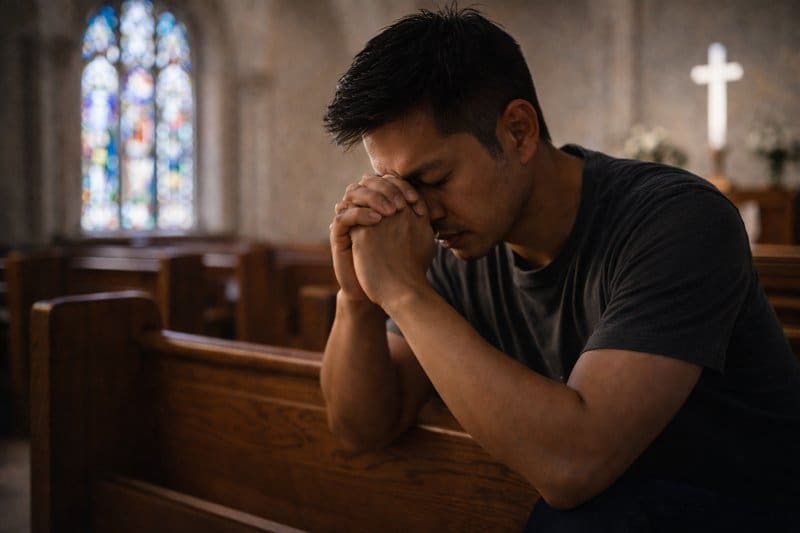

You already feel broken. You told yourself this time would be different, that you’d stop watching porn for good. But here you are again, staring at a screen… then staring at the ceiling, wondering why you keep slipping. The guilt rushes in fast and heavy. That voice in your head says you’ve failed yourself and failed God.
And then the distance creeps in, not just from people, but from Him. Prayer feels empty. Worship feels forced. Scripture feels more like judgment than comfort.
If you’ve been stuck in this cycle: mess up, feel crushed, go silent, and repeat, you’re not alone. And more importantly, you’re not beyond hope.
What you’re feeling might seem like conviction, but sometimes it’s something sneakier and more harmful: shame dressed up to look spiritual.
If you’ve ever wondered how to quit porn as a Christian, it starts right here: with the gentle reminder that even now, you are still loved and always welcome to take the next small step toward healing and grace.
Guilt That Separates Isn’t from God
It’s one thing to feel convicted when you’ve gone against what you believe. That kind of healthy guilt moves you toward repentance and change. But toxic guilt, especially around porn use, doesn’t do that.
Instead, it buries you. It convinces you that God is disappointed or done with you. You avoid prayer not out of rebellion, but out of fear. You assume God doesn’t want to hear from you until you clean yourself up.
But that’s not how God works.
Your sin doesn’t surprise Him. Your struggle doesn’t scare Him. And your healing doesn’t depend on your ability to fix yourself.
Porn Guilt Can Become a Spiritual Trap
When porn guilt sticks around, unspoken and unresolved, it slowly starts to reshape how you see God, often without you even realizing it.
Instead of seeing Him as a loving Father, you start picturing Him as a disappointed coach, arms crossed, waiting for you to finally get it right. Worship becomes something you do to prove yourself, not a way to connect with His heart. Reading the Bible turns into a checklist to earn back His approval, instead of the lifeline of grace it’s meant to be.
And then comes the hardest part: you pull away. You hide. Not because you don’t care, but because you care so deeply and feel too ashamed to say anything.
That’s not real repentance. It’s spiritual exhaustion wearing a mask. It’s performing instead of resting in love. And it’s what keeps you stuck.
How Guilt Sabotages Your Recovery
Guilt weighs you down. It quietly damages your spiritual life and sabotages your recovery.
When guilt is running the show, your motivation to quit porn comes from fear. Fear of shame. Fear of disappointing God. Fear that maybe you’re too far gone to be rescued. So you try harder, not out of love or hope, but out of panic to prove you’re still worthy.
But fear-based change never lasts. It might carry you for a few days or even a few weeks, but it can’t sustain real, lasting freedom.
Because the moment you slip, and we all slip on the road to healing, the guilt rushes back even heavier. Suddenly, it’s not just I messed up , it becomes I am messed up.
And that lie is exactly what porn wants you to believe.
Porn Guilt Isolates, Not Heals
It’s easy to believe that carrying guilt is the “righteous” thing to do; that if you feel bad enough, for long enough, maybe God will finally take you back.
But that’s not what Scripture says. The Bible tells us: “There is now no condemnation for those who are in Christ Jesus.”
That doesn’t mean sin doesn’t matter. It means your sin doesn’t get the final word.
If the guilt you’re carrying makes you pull away from God, it isn’t holy; it’s harmful.
The Holy Spirit brings conviction to lead you back to life, not to trap you in a cycle of shame and silence.
Grace Destroys Shame and Guilt
Here’s what you may have missed in your guilt spiral: God’s grace isn’t a reward for good behavior. It’s a lifeline in the middle of your failure.
That means when you mess up, grace meets you there. It doesn’t wait to show up until after you’ve strung together 30 porn-free days. It meets you right where you are.
But grace isn’t passive. It doesn’t say, “Oh, it’s fine. Don’t worry about it.” Grace acknowledges the sin and then offers freedom from it. It reminds you that your identity isn’t your addiction or your last mistake.
And when you start believing that, things begin to shift.
You don’t run from God after a relapse; you run to Him. You don’t punish yourself with silence; you cry out in broken honesty. And in doing that, you step out of hiding and into healing.
From Shame-Based to Grace-Based Recovery
The shift begins when you decide to reject guilt as your motivator and embrace grace as your foundation.
Here’s what that looks like in practice:
-
- Instead of hiding your relapse, confess it quickly and honestly to God and someone safe.
- Instead of vowing to do better, ask God to help you uncover the root cause of the struggle: stress, loneliness, anger, or unprocessed trauma.
- Instead of trying to earn forgiveness, accept that it’s already been given, and let that truth soften your heart.
Grace doesn’t remove consequences. But it does remove condemnation. And that’s what opens the door to real intimacy with God.
What to Do When the Guilt Hits
You can’t always stop the feeling of guilt from hitting. But you can choose what to do next.
Instead of spiraling, try this:
-
- Pause and breathe. Don’t rush to fix it. Just acknowledge what happened.
- Speak truth. Remind yourself: “This failure doesn’t define me. I am still loved. I can come back to God.”
- Reach out. Tell a mentor or friend what happened. Let the light in.
- And most importantly: Pray honestly. Not with fancy words, but with raw truth. Tell God how you feel, and that you still want Him close.
You won’t be met with disgust. You’ll be met with mercy.
God Isn’t Waiting for You to Be Perfect
You might feel like God is keeping His love just out of reach, watching from a distance, disappointed but reserved.
But that’s not the God revealed through Christ.
The God who leaves the ninety-nine to search for the one is seeking you. Not the perfect version of yourself, but the real, broken you—the one who stumbles yet keeps coming back.
He doesn’t want your performance. He wants your presence.
If you’re wondering how to fight lustful thoughts, remember this: healing begins the moment you stop running away and start running toward Him, even with guilt still weighing on your shoulders.
Take that step with hope, knowing you are never alone on this journey.